
ESG Reporting
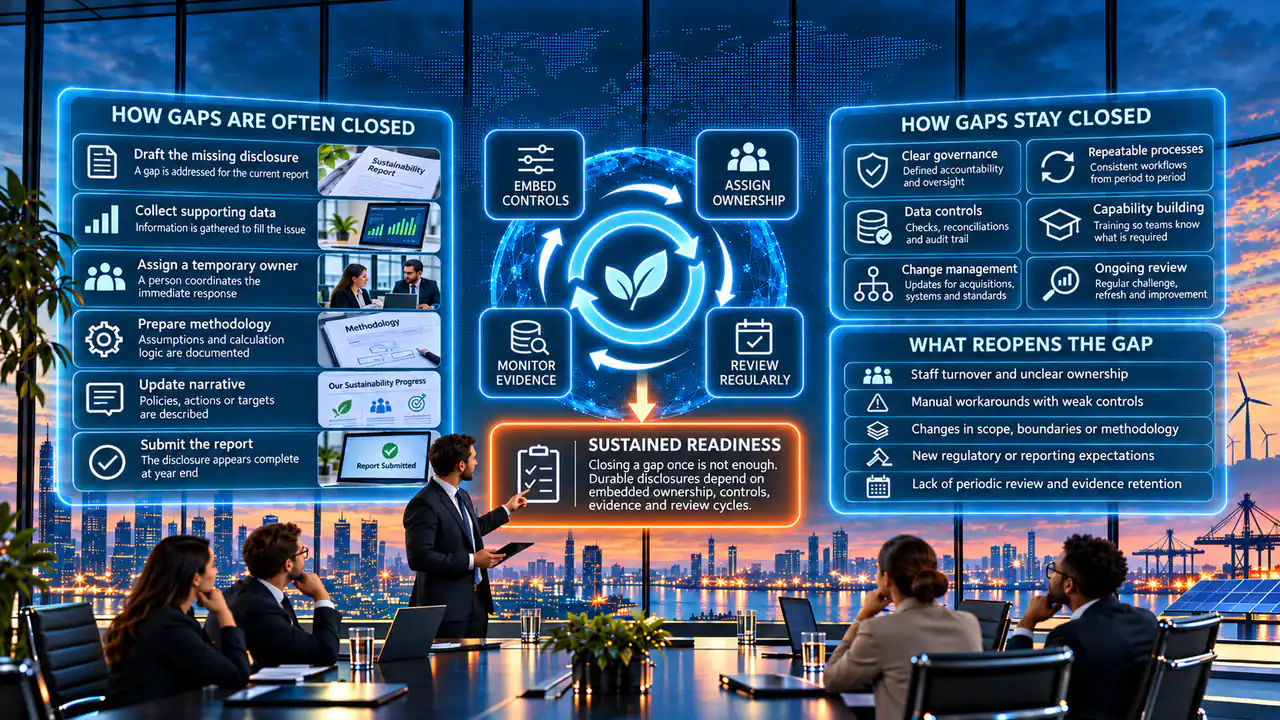
Closing a Sustainability Disclosure Gap Is Not the Same as Keeping It Closed
“We closed those gaps last year.”
A company finishes a demanding reporting cycle. It ran a gap analysis, closed many of the gaps it found and published a report it can stand behind. Twelve months later it begins again. Some of what it established still holds. Some has quietly gone out of date. Some has to be worked out afresh.
The temptation is to treat last year’s result as the current position. A prior-year green status is not evidence of current compliance. A policy may have been revised. An announced initiative may have been cancelled. A target’s baseline may have moved. A new subsidiary may have changed the reporting boundary. A requirement may have changed. Each of these can reopen a gap that the previous assessment correctly recorded as closed.
A periodic gap analysis is still worth doing, especially when frameworks or business activities change. The argument here is not to replace it. It is to preserve the knowledge it produces between assessments, so the next cycle starts from what the last one learned rather than from a blank page. This article is a companion to what makes a gap analysis meaningful, which looks at diagnosing gaps in the first place.
Sustainability disclosures have different lifecycles. They are often managed as though every one of them has to be rebuilt each year.
An annual assessment is a snapshot
A gap analysis captures a moment. It compares the disclosures that exist at the time of the review against the requirements in force at the time of the review. That is exactly what makes it useful for planning. It is also what limits it. The moment passes. The organisation keeps changing after the assessment is filed.
Two organisations can run the same assessment and manage the result very differently. One treats it as a report to be produced again from scratch next year. The other treats it as the current state of a system it keeps under review, updating individual disclosures as the trigger for each one arrives. The second spends less effort over time and is far less likely to be caught out by a gap that reopened unnoticed.
Snapshot or System
A Snapshot or Something You Maintain
Periodic assessment
Continuous management
A prior-year result is a snapshot. Between assessments, policies are revised, boundaries change and new requirements arrive. Continuous management keeps the knowledge current so each assessment confirms and extends it rather than rebuilding it.
Conceptual illustration. It does not imply that every disclosure needs continuous real-time monitoring.
Different disclosures have different lifecycles
Part of the reason annual reconstruction feels necessary is that disclosures are treated as a single category. They are not. A narrative policy and a performance figure age at completely different rates and call for different kinds of attention.
A human rights policy may not need rewriting every year. Its currency and its implementation still need confirming, because a policy that no longer reflects practice is a different problem from one that was never written. Performance data, by contrast, needs a fresh value each reporting period. Targets need progress tracked and revisions recorded. Initiatives need evidence that they were implemented and what they achieved. Analytical work such as scenario analysis or a materiality assessment has its own review requirements and cannot simply be carried forward without checking that current circumstances and requirements still support it.
The useful distinction is not stable against changing. It is the trigger that should prompt a review of each item. Set out that way, the same register that looks like a compliance checklist becomes a schedule of what to look at and when.
Not One Review Cycle
Different Disclosures, Different Lifecycles
- PolicyExample: Human rights policyReview trigger: Revision, periodic confirmation and changes in practice
- GovernanceExample: Committee responsibilitiesReview trigger: Changes in structure, mandate or personnel; periodic confirmation
- Performance dataExample: Energy, emissions, waterReview trigger: Each reporting period, with corrections when needed
- TargetsExample: Emissions reduction targetReview trigger: Progress reporting, expiry, revision or baseline change
- InitiativesExample: Energy efficiency projectReview trigger: Implementation milestones, outcomes and changes
- Analytical informationExample: Scenario or materiality analysisReview trigger: Applicable requirements, relevant changes and periodic review
- Methodology and boundaryExample: GHG calculation approachReview trigger: Changes in methods, factors, operations or requirements
- Applicability decisionExample: Industry-specific metricReview trigger: Changes in activities, industry guidance or relevant facts
Static does not mean permanently closed. It means the information has a different review trigger from the data reported fresh each period.
Illustrative review triggers only, not universal frequencies or exemptions. Framework-specific requirements, including annual reporting obligations and any reassessment rules, still apply.
Previously closed gaps can reopen
Consider a hypothetical manufacturer that could stand behind every disclosure in its last report. A year on, several of those closed gaps are open again, for quite different reasons. A policy disclosure was accurate, but the policy has since been revised and the published description no longer matches it. An energy efficiency initiative was announced in good faith, then cancelled. A reduction target was set against a baseline that has since been restated. A new subsidiary has brought activities, together with a reporting boundary, that the previous analysis never considered.
None of these is a failure of the earlier work. They are the ordinary consequence of time passing. What they share is that a statement which was true for the period it described has become inadequate to support a current assertion. That distinction between historical activity and current practice is worth holding on to. Historical evidence can remain valid for its period while saying nothing reliable about today, a point our article on what sustainability assurance actually tells you makes about evidence, completeness and currency.
Applicability moves in the same way. A fleet-specific metric may not apply to a hypothetical port operator today. A future acquisition of a shipping business would change that conclusion. The sensible response is not to delete the applicability decision once it is made. It is to retain the reasoning behind it and reassess when the relevant facts change.
The knowledge a reporting cycle generates
A reporting cycle produces far more than the report. It produces knowledge about the report: why a particular figure was unavailable, why one methodology was chosen over another, who confirmed a given disclosure, whether a target was deferred and on what basis, what evidence supported a specific claim and what the team intended to return to next year. Very little of this reaches the published document.
If that knowledge lives only in email threads and individual memory, it leaves when people do. The next team, facing the same apparent gap, repeats an investigation that has already been done once. The cost is not only the wasted effort. A decision reached carefully last year can be quietly reversed by a successor who never saw the reasoning. This is the same movement of information upstream of the report that our article on sustainability data and the sustainability report describes.
This internal layer is distinct from the published disclosure. The rationale and the supporting evidence sit behind the report, where some of it is confidential or commercially sensitive. The point is not to publish any of it. Sensitive records should stay under appropriate access controls. A management decision not to disclose something should be recorded with its reasoning and revisited, rather than being lost or, worse, assumed to have been compliant simply because it was once made.
A living disclosure register
One practical way to hold this knowledge is a living disclosure register. The term describes a general reporting-management practice rather than an official standard or a particular product. It can be a proportionate spreadsheet, a module in a reporting platform or another controlled system. Its job is to connect each disclosure requirement to the narrative, data and evidence behind it, rather than to duplicate all of that underlying information in one place.
At a conceptual level, what needs to remain known for each item is fairly consistent: the applicable requirement and its version, the current status of the disclosure, where the supporting information sits, who owns it, the reason for any outstanding gap or exclusion and when the item next needs review. None of that requires a prescribed template or a scoring scheme to be useful. It requires only that the questions can still be answered a year later.
One distinction earns its place. The status of a disclosure is not the same as the freshness of its evidence. A requirement can have been addressed last year while this year’s supporting figures are still being gathered. A policy can be unchanged while awaiting its periodic confirmation. A target can remain valid while the progress data behind it is out of date. A single combined status hides exactly the differences that tell a team where to spend its time.
The same care applies where frameworks overlap. One piece of underlying information may support disclosures under several of them. That does not make the disclosures interchangeable. Each framework’s definitions, scope and presentation requirements still need checking. Shared evidence is not the same as automatic equivalence or compliance across all of them.
Knowledge That Carries Over
Retaining Knowledge Across Reporting Cycles
Step 1
Previous disclosure and evidence
Last cycle’s statement, the supporting information and the rationale behind it.
Step 2
Review trigger
A new reporting period, a revision, a boundary change or a new requirement.
Step 3
Confirm, update or reassess
Decide which of the three the trigger calls for, then act on it.
ConfirmUpdateReassessStep 4
Current disclosure
This cycle’s statement, with evidence and currency checked.
Step 5
Retain the rationale
Keep the reasoning and evidence so the next cycle starts here, not from nothing.
The loop closes. The retained rationale and evidence become the starting point for the next cycle, which is why the following review confirms and extends the work rather than repeating it.
Keep the status and the evidence separate. A requirement can have been addressed last year while this year’s evidence is still pending. A policy can be unchanged yet awaiting confirmation. One combined status hides the difference.
Conceptual illustration, not an official standard, a workflow or a proprietary template. Framework requirements and applicability still need checking each cycle.
Ownership, assurance and continuity
Kept well, a register supports the things a reporting process depends on: clear ownership of each data point, a basis for management review, quick retrieval of evidence and a record of what changed between versions. It does not replace any of them. Underlying controls, management accountability and independent assurance remain exactly what they were. A register is a memory, not a substitute for governance.
It does help with timing. Knowing which information is stable, which needs updating and which depends on year-end processes makes the reporting timetable easier to plan. That connects to the argument that sustainability assurance is no longer the last step: when assurance and data preparation overlap, knowing the state of each disclosure in advance is what keeps the sequence manageable. An assurance provider still determines its own procedures under the engagement scope and the applicable standards. Maintaining a register does not guarantee an assurance conclusion or establish compliance.
Technology has a proportionate role. Automation can flag a changed requirement, a missing update or an approaching review date. It cannot decide whether a metric applies, whether a topic is material or whether the evidence is sufficient. Those remain judgements. A tool that surfaces the right questions earlier is valuable precisely because it leaves the answers to people.
From annual reconstruction to continuous improvement
The goal is not to eliminate every future gap. Organisations change, standards evolve and new requirements arrive. There will always be something to assess. The goal is narrower and more achievable: to preserve what the organisation has already worked out, to notice changes earlier and to spend effort on the information that genuinely needs it rather than on rediscovering last year’s answers.
Seen this way, previously identified gaps and assurance findings are inputs to improvement rather than material for a blame exercise. Where an error is found, it should be corrected and its implications for prior periods considered in line with the applicable requirements, in the same spirit as restating GHG emissions on better information. The question that matters is not who missed something. It is whether the process will recognise the same kind of change next time.
A mature reporting process does not simply close gaps each year. It retains the knowledge needed to recognise when those gaps reopen.
References
- IFRS Foundation, IFRS S1 General Requirements for Disclosure of Sustainability-related Financial Information, 2023, on the reporting period and timing (paragraph 64), comparative information (paragraph 70), the reassessment of materiality judgements at each reporting date (paragraph B28) and the correction of prior-period errors (paragraphs 83 to 86).
- IFRS Foundation, IFRS S2 Climate-related Disclosures, 2023, on greenhouse gas emissions disclosure in each reporting period (paragraph 29) and the first-year transition reliefs (Appendix C).
- IFRS Foundation, Using the SASB Standards to meet the requirements in IFRS S1, educational material, February 2024; and Using ISSB Industry-based Guidance when applying ISSB Standards, educational material, July 2025, on considering the applicability of industry-based guidance.
Verify the current versions, paragraph references and applicability dates of these sources before relying on them. The ISSB amended the greenhouse gas emissions requirements of IFRS S2 in December 2025, effective for annual reporting periods beginning on or after 1 January 2027, so confirm which version applies to the reporting period in question. The living disclosure register and the lifecycle model are editorial concepts used to explain general reporting-management practice. They are not mandated IFRS processes or a proprietary Ace CSR methodology.
Ace CSR supports Malaysian companies with sustainability reporting, IFRS S1 and S2 advisory and gap analysis and benchmarking, with an emphasis on keeping disclosures ready between reporting cycles rather than rebuilding them each year.
Explore More
Keeping your sustainability disclosures ready between reporting cycles?