
Our Services
Financial Exposure Quantification for IFRS S1 and IFRS S2
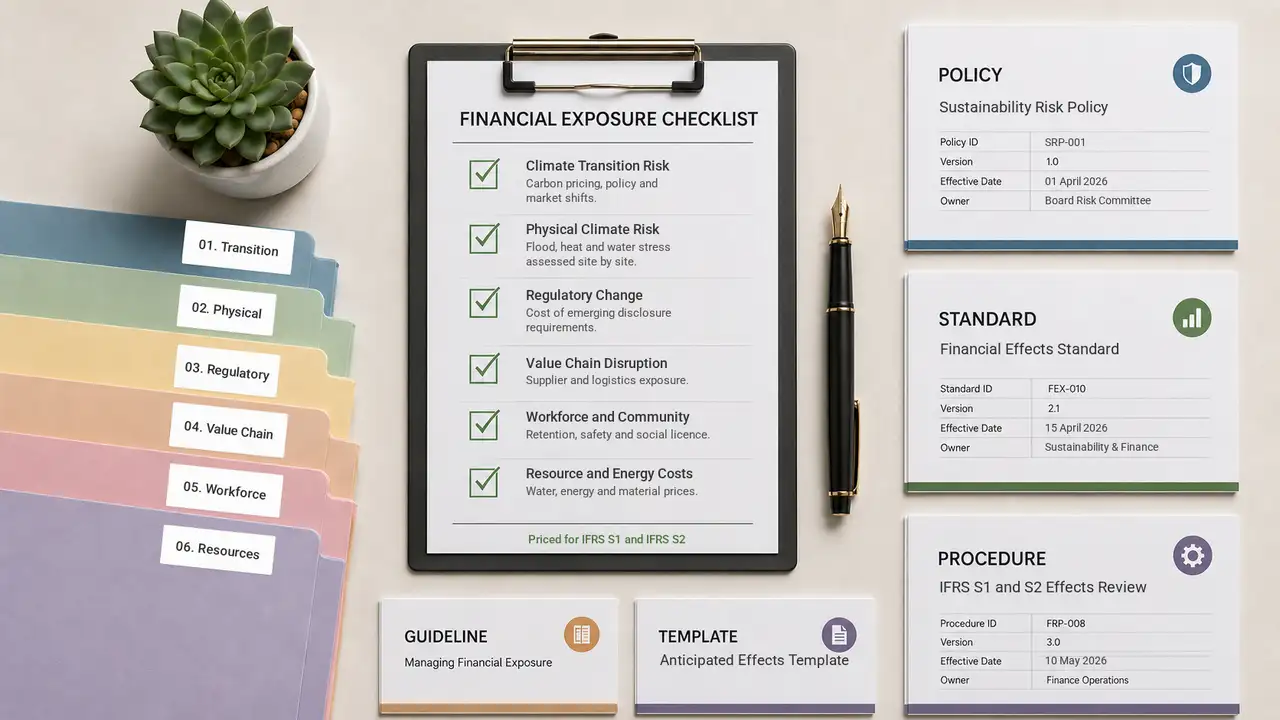
Sustainability risk, priced. Every material topic given a figure in your own currency, over your own horizons, built from your own audited numbers.
Enquire About Financial ExposureAce CSR puts a figure on sustainability and climate-related risk, so the topics in your materiality assessment reach the board and the report as amounts of money rather than adjectives.
IFRS S1 asks what your sustainability risks will do to your financial position, your financial performance and your cash flows. Most sustainability statements answer that in adjectives. Ace CSR answers it in money, and puts the workings in front of your finance team so the figures can be challenged before they are published.
What This Service Covers
A financial exposure engagement prices the material topics you have already identified. Each topic is measured against your own audited numbers, including revenue, margin, asset carrying amounts and operating measures, rather than against industry averages standing in for your business, and is expressed over the time horizons you report against.
The engagement produces two documents: a confidential working paper for your finance function, board committee and assurance provider, and a published extract structured to the standard’s own order. The extract is generated from the working paper rather than keyed by hand, so the two cannot disagree.
What IFRS S1 Asks for and What Most Statements Give
IFRS S1 does not ask whether a sustainability risk is significant. It asks what that risk is expected to do to your financial position, your financial performance and your cash flows, over the time horizons you report against. It also asks how uncertain that estimate is.
Most sustainability statements answer in adjectives. A topic is material, an impact is potentially significant, a risk is being monitored. None of that is an anticipated financial effect, and a reviewer reading against the standard will record it as absent. Pricing the topic is what turns a paragraph readers skip into a disclosure they can use, and it is the step most Malaysian issuers have not yet taken.
The Working Paper and the Published Disclosure
The working paper is confidential and written for your finance function, your board committee and your assurance provider. Every figure carries its assumptions and the document it came from. It exists to be challenged: the numbers become yours once they have been through that.
The published extract is the disclosure itself, structured to the standard’s own order with the reference against each section, so a reviewer can check coverage without reading the report twice. Because it is generated from the working paper, what your auditor reviews and what your stakeholders read are the same figures.
Who Financial Exposure Quantification Is For
Listed issuers preparing under IFRS S1 and IFRS S2, and companies whose sustainability statement is about to be read by an auditor, a ratings analyst or an index provider for the first time.
It suits you if your risks are already identified and you now need them costed. It is not a substitute for a materiality assessment, and we would not start here. Where the topic is climate, scenario analysis usually comes first and feeds the pricing.
At a Glance
Severe Case and Anticipated Financial Effect: Two Numbers, One Bridge
Each material topic, expressed as a share of its own severe case
IllustrativeSevere case
If the topic were left unmanaged
Anticipated effect
Given your strategy and committed plans
The distance between the two bars is the bridge. Publishing the severe case as though it were the anticipated effect is the most common mistake in this area, and regulators reviewing the first wave of climate disclosures have said users are entitled to the explanation.
The severe case
What a topic could cost in its worst twelve months if it were left unmanaged. It ranks your exposures and tells you where to spend your attention. It is never a provision.
The anticipated effect
What the same topic is expected to cost given your own strategy and committed plans. This is the figure IFRS S1 asks you to disclose, and it is materially smaller.
The bridge between them
Stated line by line in your working paper, so a reader can see how a large gross exposure becomes a modest anticipated one. Very few reports give that explanation.
Your Call
Four Ways to Disclose the Same Topic
Commercial sensitivity is not a reason to disclose badly. Each topic is published at the level of detail you choose, and the choice is made topic by topic rather than once for the whole statement.
A figure in money
The amount itself, in your reporting currency, over the horizons you report against.
Most specific
A share of revenue
The effect expressed as a percentage, so the shape is disclosed without naming the amount.
A defined band
A stated range in money, with the band definition on the face of the document. A range, not an omission.
No figure, with the reason
Where the standard permits it, together with the disclosures that have to accompany the relief.
Least specific
The result is a disclosure that meets the standard without putting a number on your balance sheet that you would rather not see quoted back at you.
Where It Lands
One Assessment, Four Places It Is Read
The evidence
Every material topic priced from your own audited numbers
IFRS S1
Sustainability-related financial disclosures
Current and anticipated financial effects on financial position, financial performance and cash flows, the time horizons they sit in and measurement uncertainty.
IFRS S2
Climate-related disclosures
The same for climate, including capital deployed towards climate-related risks and opportunities.
Bursa Malaysia & the NSRF
National phase-in
Malaysia’s National Sustainability Reporting Framework phases climate in first, so figures are cited by topic rather than on the assumption one standard covers everything.
Ratings and indices
S&P Global CSA, FTSE Russell
Financial-risk and financial-opportunity questions, and climate-strategy indicators scored from public disclosure. An issuer can score nothing here for want of a disclosed figure rather than for want of a managed risk.
The work is done once. What changes between these four is the wording and the level of detail, not the figures.
Reporting-Ready Outputs
Depending on the project scope, clients may receive:
- Financial exposure working paper
- Reporting-ready disclosure extract
- Severe-case and anticipated-effect figures by topic
- Bridge from gross exposure to anticipated effect
- Allocation of effects across reported time horizons
- Assumption and source register
- Measurement uncertainty statements
- Band definitions where a figure is not disclosed in full
- Financial-axis evidence for your materiality assessment
- Board and audit committee summary
Frameworks Supported
This service can align with:
- IFRS S1 General Requirements for Disclosure of Sustainability-related Financial Information
- IFRS S2 Climate-related Disclosures
- Malaysia National Sustainability Reporting Framework (NSRF)
- Bursa Malaysia Sustainability Reporting Guide
- TCFD recommendations
- S&P Global Corporate Sustainability Assessment (CSA)
- FTSE Russell ESG Ratings
- GRI Standards
Why Ace CSR?
Ace CSR works from your own audited numbers. Revenue, margin, asset carrying amounts and operating measures come from the accounts your auditor has already seen, so a figure you disagree with can be pointed at and traced back to its source.
Every topic priced is a material topic from your double materiality assessment, and the result returns to that assessment as the evidence behind the topic’s financial-axis score. The two pieces of work reinforce each other rather than sitting side by side.
Assessments are reproducible. A figure issued this year can be recomputed next year and will agree, and a change in approach never silently restates a prior year, which is what makes the disclosure defensible in front of an assurance provider.
The numbers exist to be challenged. They become yours once your finance team, your audit committee and your assurance provider have been through them, and that is the point at which they are safe to publish.
Explore More
Related Services
IFRS S1 & S2 Advisory
Place the quantified effects into IFRS S1 and S2-aligned disclosures, with gap analysis and reporting-ready content around them.
Explore IFRS S1 & S2 AdvisoryMateriality Assessment
Identify and score the topics that matter through a double materiality assessment before any of them is costed.
Explore Materiality AssessmentClimate Scenario Analysis
Assess physical and transition risk under different climate futures to inform the climate side of your financial exposure.
Explore Climate Scenario AnalysisFrom Our Insights
Further Reading
From Materiality to Money
Why a materiality score is not a financial effect and how a topic travels from the assessment to a figure a reader can rely on.
Read the article about From Materiality to MoneyDouble Materiality and Finance
Sustainability reporting no longer asks only which topics matter. It asks what they are likely to cost, and Finance holds half the answer.
Read the article about Double Materiality and FinanceQualitative vs Quantitative Analysis
Why the test of a sustainability assessment is whether its conclusion traces back to evidence, method and assumptions, not whether it contains numbers.
Read the article about Qualitative vs Quantitative AnalysisReady to put a figure on it?
Speak to Ace CSR about pricing your material topics and preparing an anticipated financial effects disclosure your finance team can stand behind.