
Climate Risk
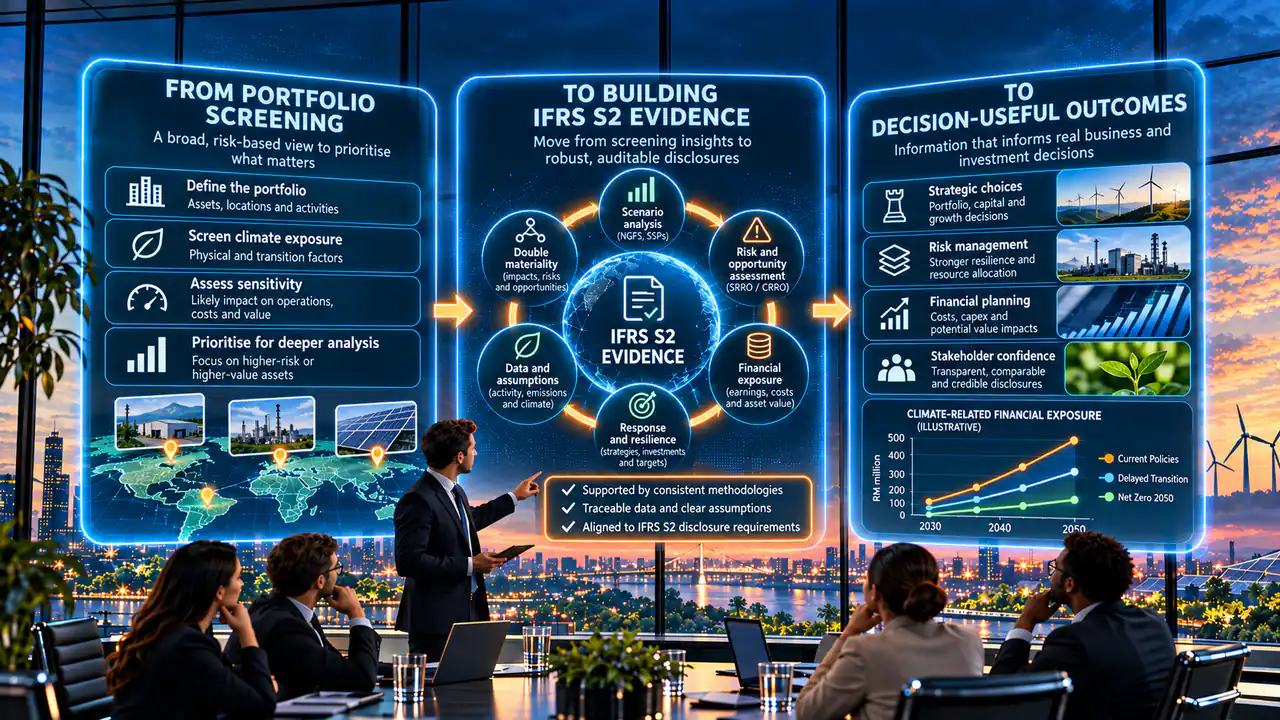
From Portfolio Screening to Decision-Useful IFRS S2 Evidence
Climate scenario analysis supports IFRS S2, but it does not complete it. A physical-risk screening of a portfolio is evidence for the resilience assessment. Materiality, financial effects, governance and strategy are judgements the organisation still has to make around it.
Climate scenario analysis has a clear and useful place in IFRS S2 work, but it is easy to overstate what a single report achieves. Used well, it becomes the first structured layer of an organisation’s climate-risk process: broad enough to cover the whole estate, transparent enough to review and disciplined enough to show where deeper work is required. This article sets out where it fits, and where it does not.
For Malaysian companies preparing for IFRS S2 under the National Sustainability Reporting Framework, the distinction matters early. Scenario analysis is often commissioned first because it produces visible outputs quickly. The risk is treating those outputs as the disclosure itself, which is part of why we argue that IFRS S1 and S2 preparation should start now, not in 2027.
Scenario analysis is evidence, not the whole disclosure
IFRS S2 asks an organisation to assess the resilience of its strategy and business model to climate-related risks across a range of scenarios, and to disclose how climate risk is governed, managed and reflected in strategy. Scenario analysis supports that assessment of resilience. A hazard report does not, by itself, establish:
- Investor materiality
- Current and anticipated financial effects
- The resilience of strategy and business model
- The effectiveness of governance, or integration into risk management
- Adaptation commitments, metrics and targets
These are organisational processes and judgements that sit around the analysis. The screening informs them; it does not replace them. Keeping that boundary clear is what makes the evidence credible.
What portfolio screening can support
Within that boundary, screening provides a great deal. It gives structured, portfolio-wide evidence on:
- Geographic exposure across the whole estate, by hazard, scenario and time horizon
- Concentrations of higher exposure, and differences between countries or business units
- Potential supply-chain exposure where supplier locations are known
- A shortlist of locations that need site-level review
- Early resilience priorities and potential operational implications
Connect physical exposure to business context
A geographic signal becomes decision-useful only when it is read against the business itself: the business model and value chain, the criticality of each asset or supplier, the employees, revenue, operating costs and production capacity that depend on it, whether a site or supplier can be substituted, insurance cover, existing controls and the timing of capital-planning cycles.
This step turns an exposure rating into business evidence. It is also where the analysis draws on people who know the assets, rather than on the model alone.
A high exposure rating is not automatically material
A location rated high for flood or heat exposure is not automatically material under IFRS S1 or IFRS S2. Materiality depends on whether information could reasonably be expected to influence the decisions of the primary users of general purpose financial reports. That is an entity-specific judgement, and a screening result cannot make it alone. It still requires consideration of magnitude, likelihood and timing, the financial pathways involved, existing controls, strategic importance, aggregation across locations, dependencies and uncertainty.
Screening helps surface candidates for that assessment and helps prioritise it. It does not pre-empt the judgement. Our article on double materiality as a finance question looks at that judgement in more detail.
Linking findings to financial effects
Boards reasonably ask what exposure means in financial terms. Screening can point to the pathways through which physical risk could become a financial effect, without turning a rating directly into a monetary loss:
- Business interruption and supply or logistics disruption
- Reduced labour productivity and higher cooling costs in extreme heat
- Asset damage, maintenance expenditure and changes to useful-life assumptions
- Insurance availability and premiums
- Water-security costs
- Adaptation capital expenditure
Quantifying any of these requires finance, engineering, operational and insurance information that sits outside the model. Transition risk follows the same logic from a different starting point: it is assessed from the organisation’s emissions and financial data against carbon-price pathways, rather than from geography. From materiality to money sets out how sustainability risks connect to financial effects more generally.
Supporting governance and risk management
Screening results are well suited to the governance and risk-management questions IFRS S2 raises. They can be used for:
- Briefing the board and management
- Populating or updating the climate-risk register
- Prioritising detailed assessments and assigning ownership
- Identifying monitoring indicators and escalation thresholds
- Integrating climate considerations into enterprise risk management
- Supporting capital and adaptation planning
Aggregation and the portfolio view
Individual assets rarely tell the whole story. A handful of high-exposure sites may matter less than a large cluster of moderate-exposure sites that share a single hazard, supplier or region. Reading results at portfolio level, rolled up by group, country, region and business unit, surfaces concentrations that asset-by-asset review misses. It also helps an organisation avoid disclosing only its most prominent locations while leaving the long tail of the estate unexamined.
Supporting resilience assessment
Resilience is assessed by comparing results across plausible scenarios and time horizons and asking whether the strategy still holds. Good analysis does more than produce maps. It helps management answer what changes and when, which assets or activities are affected, what controls already exist, what actions are available and which assumptions or uncertainties could change the conclusion.
Limitations and traceability
A report that supports governance and review must document how it was made: sources, methods, model versions, baselines, scenarios, time horizons, spatial resolution, assumptions, limitations, data gaps and intended use. That supports repeatability and lets a reviewer trace a result back to its inputs. It does not mean an assurance provider endorses the analytical conclusion, a distinction our article on what sustainability assurance actually tells you explores.
Conclusion
Portfolio screening is most valuable as the first structured layer of an organisation’s climate-risk process. It does not complete an IFRS S2 disclosure. It provides the evidence base from which a credible disclosure can be built, and shows where deeper operational, financial or site-level work is needed.
Screening tells you where to look. Materiality, financial effects and resilience are what you conclude once you have looked.
Ace CSR supports Malaysian companies with climate scenario analysis and IFRS S1 and S2 advisory. The screening itself is delivered through our specialist service, Scenario Analyses, which publishes its methodology and sample outputs.
Explore More
Turning climate scenario analysis into IFRS S2 evidence?